


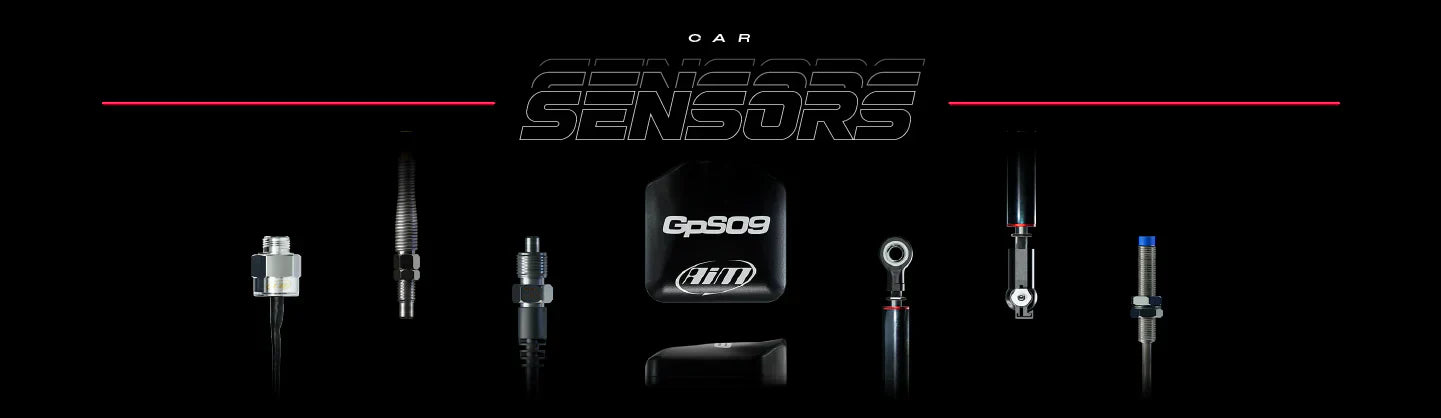
Every build is different, so the best sensor really depends on your vehicle, integration with your existing setup and your motorsport goals. Some sensors are vital to run the vehicle, whereas other sensors are specific to motorsport data logging. In this car racing sensor series, we will discuss which motorsport sensors we recommend to suit various requirements and how to decide which sensors are best-suited to your setup.
How Do Sensors Work In Car Racing?
Sensors are the backbone of any successful car racing setup. While some sensors are vital for operating the car, others are vital for monitoring vehicle and driver performance to remain competitive on the track.
They continuously measure physical quantities—like temperature, pressure, position and speed—convert them into electrical signals, and send this data to the Electronic Control Unit (ECU) or onboard loggers. Teams can then use this data to monitor telemetry, optimise performance and prevent mechanical failures.
Which Motorsport Sensors Do I Need?
The best motorsport sensor depends on what data you want to capture or what your racing goals are. As a general guide, you should follow 4 key points when choosing which motorsport sensor is best for your car racing setup.
1. Define What You Want To Measure
Understand what you want to measure and which sensor best suits your motorsport needs.
Engine Management (ECU Essential)
These sensors are required to safely run an engine:
-
Lambda (Oxygen) Sensor: Analyses exhaust gases to ensure the optimal air-fuel ratio for engine safety.
-
Manifold Absolute Pressure (MAP) Sensor: Measures the internal pressure of the intake manifold to calculate air density and dictate correct fuel delivery.
-
Throttle Position Sensor: Monitors the precise angle of the throttle pedal or butterfly valve for engine load calculations.
Vehicle Dynamics & Chassis Control
These sensors help decode driver inputs and chassis reactions:
-
Wheel Speed Sensors: Utilise Hall-effect or inductive technology to monitor individual wheel rotation rates, which is critical for traction control and ABS.
-
Brake Pressure Sensors: Analyse pedal consistency and threshold braking across individual corners to shave lap times.
-
Suspension Position Sensors: Use linear potentiometers to track suspension travel, providing critical data on damper performance and chassis roll.
-
Steering Angle Sensor: Measures the steering wheel's position to validate the intended trajectory against vehicle yaw.
-
GPS & Lap Timing: Records exact lap times, speed and track positioning, helping drivers understand where they are losing or gaining time.
Fluids & Cooling
These sensors protect your investment and monitor thermal efficiency:
-
Pressure Sensors: Vital for monitoring engine oil, fuel and coolant pressure to enhance performance, safety and vehicle control.
-
Temperature Sensors: Use fast-response thermistors or infrared sensors to monitor engine coolant, oil and intake air temperatures.
-
Fuel Level Sender: Records fuel level to determine how much fuel is required for the race session, minimising excess weight.
2. Choose The Sensor Range
Choose a sensor whose operating range provides the best resolution for your ECU or data logger, while leaving a safe margin. As a rule of thumb, you should opt for a sensor that is 1.5 to 2 times your normal bar range to protect against over-pressure spikes. For example, if your system normally operates at 6 bar, you should opt for a 0-10 bar sensor.
3. Consider Environmental Constraints
Motorsport sensors differ from road car sensors due to the intense environment they endure. When choosing a car racing sensor, consider:
-
Vibration & G-Forces: All Aim sensors are designed with motorsport environments at the forefront, ensuring wires and connections are secure.
-
Temperature Rating: Engine and exhaust systems require sensors with extended temperature ranges (often up to 150°C to 300°C).
-
Size: Compact sensors without excessive wiring reduce unnecessary weight and cables that can get in the way.
4. Compatibility
Determine whether the ECU or logger requires an analogue signal (such as a 0-5V output) or a digital signal (such as CAN Bus). Using expansions like the Aim ACC3 allows you to connect up to four analogue or thermocouple sensors and transmit them to your logger via a single, lightweight CAN interface.
Installation & Maintenance
Every car and racing setup is unique, and incorrectly installing any motorsport sensor can result in inaccurate readings. As a general guide, here are some tips and tricks that you can follow to get the most out of your car racing sensors:
-
Follow official manufacturer guidelines and technical sheets.
-
Ensure sensors are secure and not loose.
-
Recalibrate sensors for accuracy.
-
Regularly clean and inspect sensors for wear or damage.
-
Speak to our experienced technicians if a sensor needs to be repaired.
Keep your eyes peeled for more information on our car sensor series, where we explain how to install specific sensors in your racing car, their benefits when it comes to motorsport telemetry and so much more! If you have any questions about which sensors are right for your setup, contact our support team who are always on hand to help. After all, your data system is only as good as the sensor connected to it.
FAQs
Can I use grounded sensors in motorsport applications?
Grounded sensors are generally avoided in most motorsport applications because they can pick up severe electrical noise, which can affect your data. If you are using a grounded sensor, always use the dedicated sensor ground pins on the ECU or wiring harness.
What can I do if there’s moisture in my sensor?
Moisture in the sensor can often cause sensor malfunctions or inaccurate readings. To clean/dry the sensor, start by disconnecting it, spray the sensor with a specialist cleaner and allow it to air dry before reconnecting.
Share:
How to Read and Improve Your Lap Times with Aim RaceStudio 3