


When it comes to going faster on track, data is one of the most valuable tools you can have. Whether you're competing in club motorsport, endurance racing or simply enjoying regular track days, understanding what your car is doing can help you improve your driving and make smarter setup decisions.
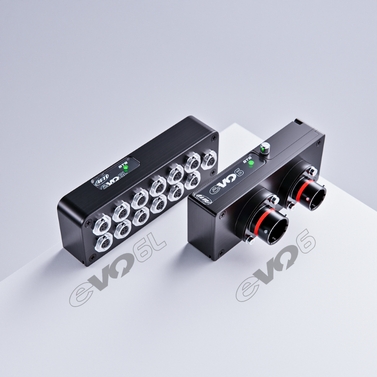
Both are part of Aim's latest generation of data loggers, offering professional-level performance and reliability. While they share many of the same features, there are a few key differences that make each model better suited to different types of racers.
Why use a data logger?
It's easy to focus on lap times, but they only tell part of the story. A data logger records information from your vehicle's ECU, GPS and sensors, giving you a much clearer picture of what's happening every time you head out on circuit.
By reviewing your data after a session, you can identify where you're braking too early, getting on the throttle too late, or carrying less speed through corners than you thought. It also allows you to monitor engine performance and compare different setup changes, helping you make decisions based on facts rather than guesswork.
The Aim EVO6
The EVO6 is designed for racers and teams who need a highly capable, expandable data logging system. It supports over 2,000 ECU protocols and can collect information from a wide range of sensors, making it suitable for everything from club racing to professional motorsport.
With eight configurable analogue inputs, four speed inputs and support for additional Aim expansion modules, the EVO6 has plenty of capacity if your vehicle is fitted with multiple sensors or you're planning future upgrades.
Other features include:
- Integrated 25Hz GPS
- Six-axis inertial platform
- Built-in Wi-Fi and Bluetooth
- Dual digital outputs
- Expandable storage using an SD card
It's an excellent choice that includes more advanced data requirements or teams that want room to expand their system over time.
The Aim EVO6L
The EVO6L uses the same core technology as the EVO6 but in a smaller, simpler package.
It still offers the same fast GPS, ECU connectivity and reliable data logging, but with five analogue inputs and two speed inputs instead. For many club racers, that's more than enough to monitor vehicle performance and analyse driving.
The compact design also makes installation easier, particularly in cars where space is limited or in motorcycle applications.
Key features include:
- 25Hz GPS
- Six-axis inertial platform
- Built-in Wi-Fi and Bluetooth
- Five analogue inputs
- Two speed inputs
- 4GB internal memory
If you don't need many sensors, the EVO6L offers outstanding performance without paying for features you may never use.
What's the difference?
At their core, both units provide the same accurate data logging, GPS performance and compatibility with Aim's Race Studio 3 software. The main difference is expandability.
The EVO6 offers more inputs, greater storage capacity and additional outputs, making it the better option for complex race cars or anyone expecting to add more sensors in the future.
The EVO6L, meanwhile, keeps things straightforward. It delivers the same performance in a more compact package, making it ideal for club-level motorsport, track day cars, motorcycles and lightweight race builds.
Which Data Logger is right for you?
If your car already has several sensors fitted, or you're planning to add Aim suspension, brake pressure or temperature sensors later on, the EVO6 is the easy choice.
However, if your priority is reliable, professional-quality data logging without unnecessary complexity, the EVO6L is all you need.
Whichever model you choose, both are built around the same trusted Aim platform and are easily compatible with Race Studio 3, giving you the tools to review your sessions, compare laps and make informed improvements every time you head out on track.
Improving your performance isn't always about adding more power. Often, the biggest gains come from understanding how you drive and making small, informed changes.
Both the Aim EVO6 and EVO6L are designed to help you do exactly that. Whether you're chasing tenths in competition or simply looking to get more from every track day, either logger provides the accurate, dependable data needed to keep moving forward.
The right choice simply comes down to how much data you want to collect today, and how much you might want to collect in the future.
Share: