


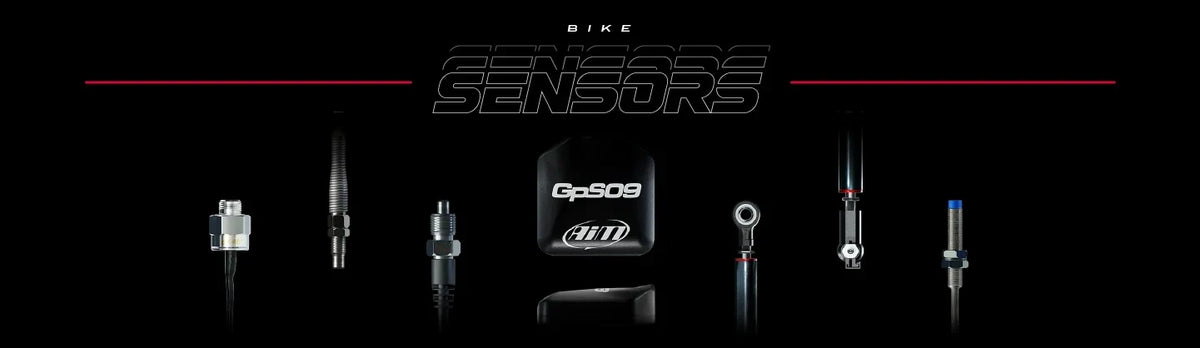
Every build is different, so the best sensor really depends on your motorcycle, integration with your existing setup and your motorsport goals. Some sensors are vital just to run the motorcycle, whereas other sensors are specific to motorsport data logging and analysis. In this motorcycle racing sensor series, we will discuss which motorsport sensors we recommend to suit various requirements and how to decide which sensors are best-suited to your setup.
How Do Sensors Work In Motorcycle Racing?
Sensors are the backbone of any successful motorcycle racing setup. While some sensors are essential just to operate the motorcycle, others exist purely to monitor motorcycle and rider performance to remain competitive on the track.
They continuously measure physical quantities — like temperature, pressure, position, speed and lean angle — convert them into electrical signals, and send this data to the Electronic Control Unit (ECU) or onboard loggers, such as the Aim Solo 2 DL. Riders and teams can then use this data to review telemetry, fine-tune the setup, and catch mechanical issues before they become race-enders.
Which Motorsport Sensors Do I Need?
The best motorsport sensor depends on what data you want to capture and what your racing goals are. As a general guide, you should follow these 4 key points when choosing which sensors are best for your motorcycle racing setup.
-
Define What You Want To Measure
Understand what you want to measure and which sensor best suits your motorsport needs.
Engine Management (ECU Essential)
These sensors are required to safely run an engine:
- Lambda (Oxygen) Sensor: Analyses exhaust gases to ensure the optimal air-fuel ratio for engine safety and performance.
- Manifold Absolute Pressure (MAP) Sensor: Measures intake manifold pressure to calculate air density and dictate correct fuel delivery.
- Throttle Position Sensor: Monitors the precise angle of the twist-grip throttle for engine load and mapping calculations.
- Gear Position Sensor: Reports which gear is engaged, essential for quickshifter/blipper systems and for correlating engine data with gear selection on the data trace.
Vehicle Dynamics & Rider Input
These sensors help decode rider inputs and how the motorcycle is reacting:
- GPS & Lap Timing: Records exact lap times, speed and track position, so you can see exactly where you're gaining or losing time versus a reference lap.
- Wheel Speed Sensors: Hall-effect or inductive sensors measure individual wheel rotation. Comparing front vs rear speed is critical for spotting wheelspin, wheelies and rear-wheel lock-ups under braking.
- Brake Pressure Sensors: Motorcycles run separate front and rear brake circuits, so measuring each independently reveals braking bias, trail-braking technique and threshold braking into each corner.
- Lean Angle / IMU (Inertial Measurement Unit): A 6-axis IMU tracks lean angle, pitch and yaw rate, letting you analyse how hard you're leaned over mid-corner, spot wheelie and stoppie events, and understand corner entry/exit dynamics.
- Suspension Position Sensors: Linear potentiometers fitted to the front fork and rear monoshock track suspension travel, providing critical data on damper performance, weight transfer and chassis pitch under acceleration and braking.
Fluids & Cooling
These sensors protect your investment and monitor thermal efficiency:
- Pressure Sensors: Vital for monitoring engine oil and coolant pressure to protect the engine and maintain performance.
- Temperature Sensors: Fast-response thermistors or infrared sensors monitor engine coolant, oil and intake air temperature.
- Fuel Level Sender: Tracks fuel level to determine how much fuel is required for the race session, minimising excess weight.
-
Choose The Sensor Range
Choose a sensor whose operating range provides the best resolution for your ECU or data logger, while leaving a safe margin. As a rule of thumb, opt for a sensor that is rated at 1.5 to 2 times your normal operating range to protect against spikes. For example, if your system normally runs at 6 bar, you should opt for a 0–10 bar sensor.
-
Consider Environmental Constraints
Motorsport sensors differ from road motorcycle sensors due to the demanding environment they endure. When choosing a motorcycle racing sensor, consider:
- Vibration & G-Forces: Motorcycles generate high-frequency vibration and rapid lean transitions; all Aim sensors are built for motorsport environments, with secure wiring and connections designed to handle this.
- Temperature Rating: Engine and exhaust systems require sensors with extended temperature ranges (often up to 150°C to 300°C).
- Size & Weight: Compact sensors without excessive wiring reduce unnecessary weight and keep cabling away from moving parts, suspension components and the rider's legs.
-
Compatibility
Determine whether your ECU or logger requires an analogue signal (such as 0–5V) or a digital signal (such as CAN Bus). Once you've fitted your core sensors, you may find you want to capture more channels than your ECU or logger has inputs for.
This is where expansion modules like Analogue to CAN Converters (ACC) come in. The Aim ACC3 allows you to connect up to four analogue or thermocouple sensors and transmit them to your logger via a single, lightweight CAN interface. Working with the Solo 2 DL and other Aim Data Loggers, the ACC3 makes it easy to expand your data acquisition setup as your needs grow.
Installation & Maintenance
Every motorcycle and racing setup is unique, and incorrectly installing a sensor can result in inaccurate readings. As a general guide, here are some tips and tricks that you can follow to get the most out of your motorcycle racing sensors:
- Follow official manufacturer guidelines and technical sheets.
- Ensure sensors are securely mounted.
- Recalibrate sensors regularly for accuracy.
- Regularly clean and inspect sensors for wear or damage.
- Speak to our experienced technicians if a sensor needs to be repaired.
Keep an eye out for more instalments in our motorcycle sensor series, where we'll cover how to install specific sensors on your race bike and the telemetry benefits each one brings. If you have any questions about which sensors are right for your setup, contact our support team, who are always on hand to help. After all, your data system is only as good as the sensor connected to it.
Share:
Everything You Need To Know About Lambda Sensors